The liberal arts will set you free
Some truths to hold self evident
as we in the United States near the July 4 holiday.
The liberal arts liberate.
The constellation of disciplines we label the liberal arts is ancient. What came to be called the artes liberales (“the arts suitable for a free person”) reach back to classical Greece and Rome, where education in rhetoric, grammar (which includes literature), logic, mathematics, music, geometry, astronomy was understood as preparation for robust participation in civic life. Note all the exclusions built into a term that derives from liber (free man), given that most of the world would be excluded from such a category. Yet every age develops the liberal arts it needs, and the historical trajectory of education under that designation has been towards reinvention and widening of access. An accelerant for agency, the liberal arts exceed their own mission. They are the guarantor that history is not destiny and origin is not fixed identity. The study of the liberal arts is intimate to the liberation of self from fixity and expectation.
Freedom is not personal.
If the liberal arts can set free those who engage with their challenge, it’s worth noting that such liberty does not become an individual possession. Libertarians who believe that freedom is singular, theirs alone, are narcissists. The liberal arts cultivate a free person whose work is to ensure that future generations have as many choices as they do. To study the liberal arts is to become a libertarian in a renewed sense: libertarian who safeguards the power of self-determination for generations to come, liberty for ourselves and our posterity.
Freedom is generosity.
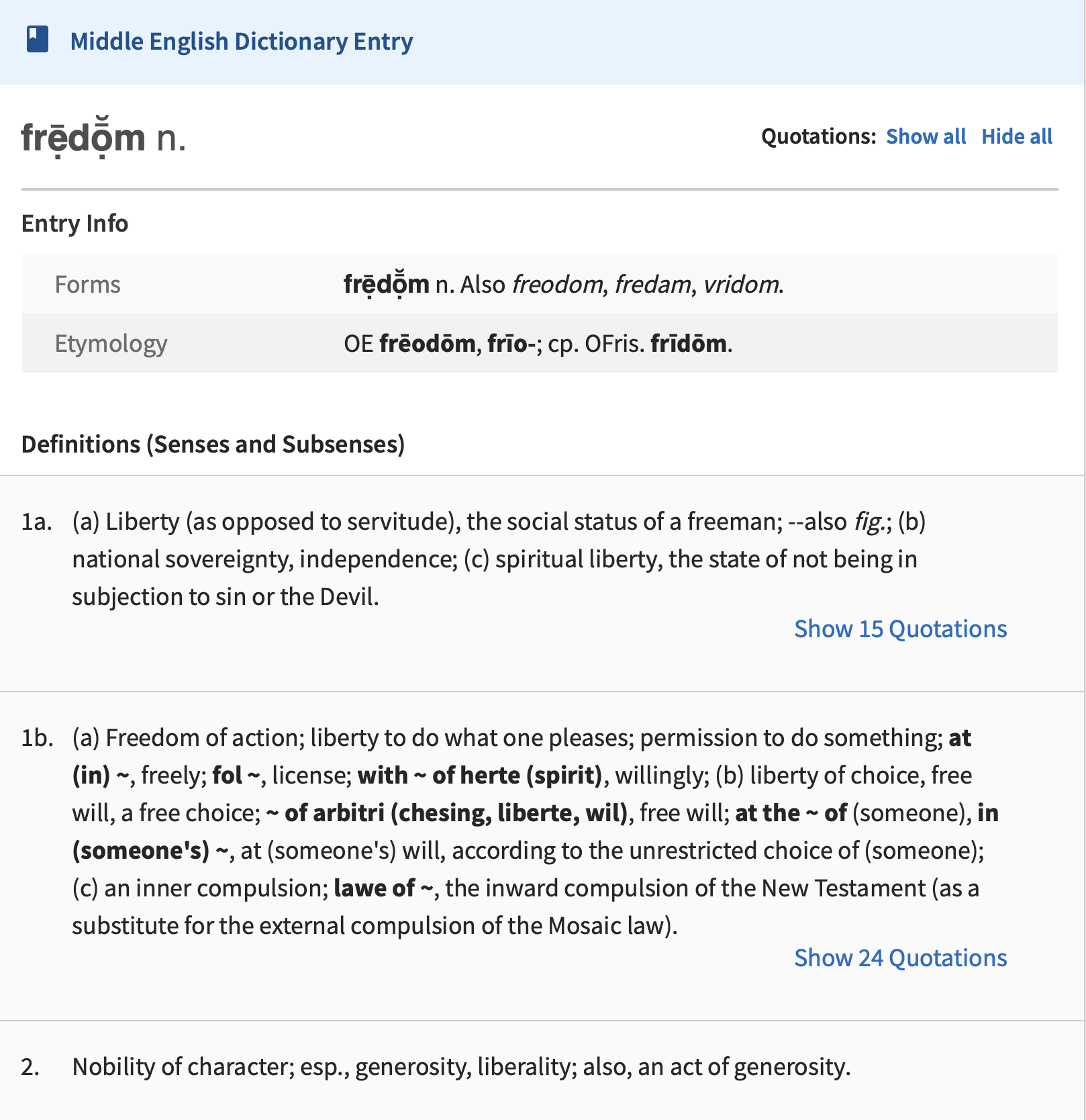
A strange thing happened to the word freedom over time. Whereas we now tend to think of freedom as an individual right that amounts to a privilege to be exerted in a rather self contained way (“I am free to do X”), the word has traveled the same expansive road as Latin liber: from frẹ̄ designating a non-servile man (a constricted way of exerting meaning) to fre as a Middle English word denoting openhandedness, generosity, wholeheartedness, liberality. From a right to a responsibility: to be free is to be generous, which is say, to multiply possibilities for a wide community of friends and strangers. The liberal arts have always been about ethical judgment — and you can’t have ethics without an ethos, a way of being that is larger than a self.
The liberal arts are a practice of citizenship.
Their strength resides less in specific content but their ability to foster the capacities that citizens need to contribute meaningfully to the general welfare: communication, reasoning, ethical discernment, quantitative ability, literacy, an understanding of how a complicated world works and how to shift its trajectory towards the common defense and the good. You cannot establish justice without a wide sense of how to mend a broken world. You cannot have a thriving democracy without thriving liberal arts. (It is therefore always telling to see who is attacking educational institutions.)
Every generation creates the liberal arts it needs.
Ours seems to be coming into ever sharper focus now as social media, AI, and other technologies we have built have upended the comfortable and the secure. Liberal arts education cultivates free persons who foster freedoms for future worlds — quite the opposite of the solitary agents that attention-fracking technologies promote, where individuals are reduced to algorithms and data sets for product optimizations and dreary commerce. That’s not generous, and not free. Now wonder we see a return to the challenging interdisciplinary study that exceeds the confines of mere preprofessional training. The student who wants a good job and the student who wants a good life are the same person.
The liberal arts are for everyone.
An accidental but sublime convergence is hidden within the phrase “liberal arts.” The noun liber carries two unrelated meanings, from two distinct Indo-European stems. On the one hand liber means “free.” On the other, liber designates the bark of a tree — one of first writing materials, and therefore the word that becomes “book.” The liberal arts are as practical and as necessary as a public library. They are rooted in books, ideas, shared inquiry, generous learning. They can as easily be accessed in a public space as a highly selective college. But their ultimate purpose is freedom: the freedom to think critically and wholeheartedly, to act responsibly, to imagine alternatives, and to participate fully in the life of a civic community, a more perfect union.