when students fail
If the majority of my students failed my course's final assessment, I would blame myself. I should have designed a course that engaged them from the start, challenged them at every turn, and supported their learning journey. A final assessment that is not a moment of triumph for the majority of the class would be on my shoulders, not theirs.
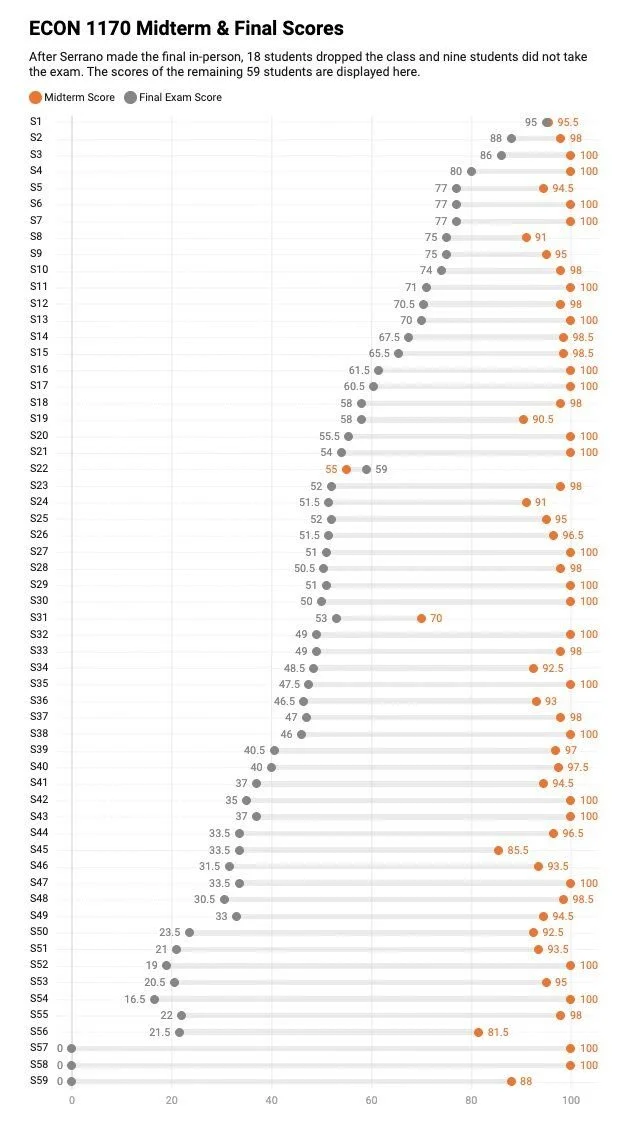
If you're an educator and have been on social media over the the past few days, you've seen the image at the bottom of this post, comparing the grades on a take home midterm and in-class final for Brown students in an economics class. The professor suspected that his students were using AI to do their work for them, then used this change of assessment to prove it. Mostly the anecdote and chart have been shared with a smug "Students use AI to cheat their way through everything" moral.
Alternative narrative: when this many students fail an exam, and thereby likely fail a course, the responsibility is on the professor for being an educator who did not design the class so that all could succeed. Blaming the students in a university course for being lazy or not as smart as previous generations or lacking in dedication is a trope going back to the monasteries out of which universities sprang ("novices these days!"). It's never a good look for faculty or administrators to describe a pedagogical failure as a sign of how bad students are "these days."
Some colleagues who in a previous era urged faculty to meet the students where they are rather than punish them into performance have in a post-AI age now quietly reversed themselves. As satisfying as they might feel to the professor, reactive measures like mass disciplining through a sudden change in modality of a final exam are not solutions. Student engagement and success have always offered an invitation to pedagogical strategy and creativity. If we can’t muster the vigor to rise to the challenge of reinvigorating the learning process, then students will continue to fail. And there will be plenty of culpability to share.
[Addendum: the comments this thought engendered on LinkedIn sometimes saddened me with their low regard and even contempt for students. Many of those who wrote seem to consider students as inveterate cheaters looking for the easiest way out, constitutionally incapable of rising to the challenges that education demands. I have begun to see that anger at AI having changed how effective pedagogy must unfold has transmuted into anger directed at students -- I suppose for making methods assumed to have worked for the past twenty years no longer work (reader: they never worked as well as they were thought to). I spent my day thinking about a redesign of some our entry level writing courses that starts with what skills and capacities we want our students to have cultivated and works backwards from there, acknowledging that we live in a time when thinking about writing and argument means thinking critically about AI. That redesign is not worth the time if we don't start with the assumption that students are doing their best in a hard world; we want to engage them and ensure they are clear why we ask them to do what they do as part of their training. Every student should be supported towards success, not dismissed out of hand by demeaning assumptions or punitive evaluative mechanisms. We all have a lot of hard work ahead.]