
(draft for a forthcoming collection, for which I’ve composed an afterword)
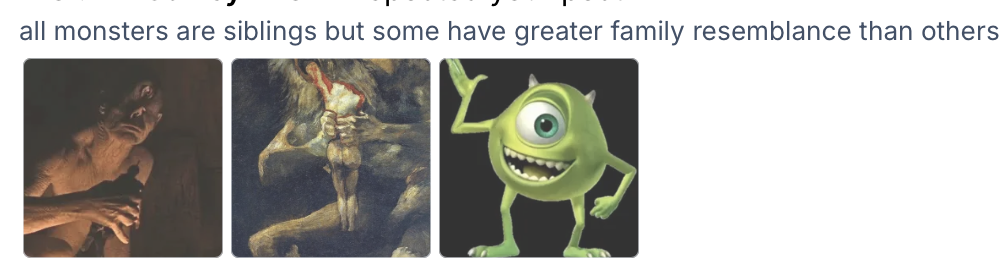
As an undergraduate I intended to study biology, but literature got in the way. Or maybe it was the monsters. During my sophomore year of college, Old English pulled me into its wash of words weirdly familiar yet stubbornly strange. A noun like mearcstapa (border-walker) is close enough to our modern tongue that glimpses of immediate meaning beckon (a mearc or mark is a border, stapa is a step), distant enough that understanding demands struggle.[1]Ðā cōm of more under misthleoþum / Grendel gongan, godes yrre bær: learning to read Beowulf in its original rhythm and language meant stepping into alien cultural and linguistic realms, not just early English but the disparate traditions crowding medieval Britain. In off the moors, spoiling for action, / God-cursed Grendel came greedily loping: that challenge also required a fair amount of unlearning, setting aside prejudices about the past and its people, embracing the ethical intricacies that ancient writers seem so much better at plumbing.[2] Classical and medieval literature often explores such complexities through the monster: giants, cannibals, dog headed men, revenants, dragons, hybrid creatures whose forms refuse diminution into the tidiness of the known. Monsters elicit curiosity, a word that derives from care and solicits ethical relation. The iron-braced door / turned on its hinge when his hands touched it: demanding attention while providing no security of meaning, they throw wide the gates to language study, historical engagement, forgotten religious traditions, ceaseless political struggle, ecological entwinements, imaginings of the body that challenge and entice.[3] Strange to think of the intimacy of monstrous trespass to what makes humanistic study so enduringly powerful. An invitation or a summons, monsters make clear that we have always dwelled in a world crowded with beings that blur every line supposed to be demarcative, that no knowledge is secure from challenge.
Monsters have long been following me as well as leading me forward. Academic adventures in monstrous study were for me a continuation of childhood dreams, books, and films about strange creatures from the edges of insight. These preoccupations spurred in time a collaborative project called Monster Theory: Reading Culture (1996), a colloquy built on a conviction shared among some scholars that monsters undertake essential cultural work. By enfleshing desires, anxieties, hopes, prejudices, and possibilities into astonishing forms monsters spur narration, image making, remembrance, revision, invention. Monsters proliferate (as my litany loving sentences indicate). They suggest not some unknown beyond the human so much as how we as limited beings struggle to understand our shared incoherence. While Monster Theory committed itself to an exploration of what monsters reveal about the cultures that dream them, lately I have been more interested in what monsters make possible, their invitations to a differently configured world. I recently did a podcast interview with Isabella Shock, a student of Japanese language and culture at Arizona State University, where we talked about her research on yōkai.[4] This creaturely category is often translated as "supernatural beings" or "spirits,” but these flat terms flatten their intricacy. Some yōkai appear as ghosts, or animals, or animate objects. Some are dangerous, even deadly; others are merely mischievous. All resolutely refuse easy inhabitance of the quotidian. Yōkai complicate much Western thinking about monstrosity, especially when monsters are enemies exterior to human community, threatening the civilized from the map’s edge. Yōkai are remarkably uninterested in binaries. Presences demanding sustained attention, they dwell in worlds that impinge the everyday, inviting a discerning subject to witness the remarkable. When monsters already share the known world, their invitation is to coexistence, expanding conceptions of neighboring. How do we live in abiding adjacency to that which escapes full knowing?
To welcome the monster means to dwell as citizens of a shared world – an increasingly difficult aspiration, considering the monster-making unfolding in the United States as I write. A totalitarian fervor has taken hold for classifying bodies by their productivity, beauty, health, physical and cognitive ability, citizenship, race, gender, geographical origin. We monsterize in order to banish and exclude the humans we refuse to call “fellow,” claiming safety is stake. Because they challenge such narratives of immunization and quarantine, monsters can trigger deep fear, demonstrating the fragility of realities that only seemed immutable. Neither terror nor walls long hold – or as I wrote thirty years ago, fear of the monster is really a form of desire. In their company we will laugh. We will feel sorrow when they pass. Sometimes we will want to become them. An embodiment of contamination, death, and insatiable appetite, the vampire is a seductive lover, a tragic outsider, glamorous aristocrat, misunderstood teenager, queer icon, aesthete, artist, antihero -- a tumult of perplexing response.
The monster slows the wheels of interpretative containment and asks us to sit within uncertainty. Possibility emerges here. In such lingering ethical relation begins: with curiosity, with care. At the the end of Monster Theory, I wrote a line that still haunts me. Monsters are our children. Monsters certainly demand attention and responsibility; they cannot be disowned. Yet monsters are also parents, ancestors, descendants. They belong to every generation and make a mess of time. Monsters come before us, travel with us, outlast our every endeavor. Every age inherits monsters it neither invented nor sought, reshapes them to puzzle through its own complexities, then releases them as a force of future-making. A guest (welcomed or not) changes the household through their arrival. Hospitality demands making room for what you cannot fully predict, comprehend, or control. Monsters radicalize that principle. Welcoming the monster transforms the home, unsettles belonging, asks us to trade mastery for coexistence. A world where monsters abide is a world where difference flourishes. Such environs are not easy to inhabit, for dwelling there demands humility, attention, abandoning the fantasy that what exists exists for us.
The world was never ours alone.
[1] I chose this word not only because it so well conveys the work of monsters as boundary-treaders but is also an acronym for a scholarly society dedicated to the study of monsters, MEARCSTAPA (Monsters: the Experimental Association for the Research of Cryptozoology through Scholarly Theory and Practical Application) https://www.mearcstapa.org
[2] Translation by Seamus Heaney, Beowulf: A Verse Translation (New York: Norton, 2002), lines 709-10.
[3]Beowulf trans Heaney lines 721-22.
[4] See the Asia Center at ASU’s YouTube channel: https://www.youtube.com/watch?v=pxlPyZHbLDc&t=2s